If you are planning on getting your Microsoft Access Certification then it is possible you are nervous about taking the exam and even more so about your Access training. Luckily, Onsite Access training does not have to be that difficult if you just know how to get started and what to study. That is generally the most difficult part of studying anyway, figuring out what is most important and then learning it. Fortunately, there are quite a few ways to make Microsoft Access certification easy.
The first option for you is to use Access training videos. The videos are excellent because they allow you to sit down and “watch” the information that you need to learn. This is an active form of learning that feels passive. In other words, you are sitting and learning the information that is placed on the screen in front of you. This is a great option for many people who simply don’t like sitting down with a book and reading. With the Access training videos you sit, watch, take notes if you want, and learn what is necessary for the exam. Even if you are a self studier you will likely benefit from the videos because they will help you affirm what you have already learned and refresh your knowledge and specific topics.
An Access training CD is also a big help. With the training CD you simply place the disc in your CD player and listen to the relevant information. This is a perfect way to study while on your way to work or doing practically anything else including working out, cleaning the house, or anything else where you can listen. Lots of people say they don’t have time to study and they may not have time to sit down with a book and read for hours a day. However, they can take advantage of the CD to listen to the important information they will need to know for the exam while they are going about their busy lives.
These are just a couple of the ways you can study for Microsoft Access certification without having to sit down with a book and read on your own the information. Sometimes people learn more when the information is presented on video and CD because they have an open mind about learning the information. Whatever your case, consider these tips when you are studying for Microsoft Access certification because they may just work for you.
Caitlina Fuller is a freelance writer. The first option for you is to use Access training videos. The videos are excellent because they allow you to sit down and “watch” the information that you need to learn. An Access training CD is also a big help. With the training CD you simply place the disc in your CD player and listen to the relevant information.
http://EzineArticles.com/?expert=Caitlina_Fuller
Wednesday, October 3, 2007
CD Storage Cabinets
CD storage cabinets are the perfect means to accommodate a growing CD collection. CD storage cabinets assure maximum protection for a CD collection from moisture and scratches and are ideal for long-term storage. CD storage cabinets can be mounted on a table, near the CD player, or can be clamped on the wall.
CD Storage cabinets come in various sizes and designs and are an excellent combination of form and function. Contributing to the ambience of a room, CD storage cabinets are ideal accessories for a home theatre system. Some of these cabinets have separate racks to store the CDs, which offer a suitable storage and retrieval option. For quick access, some more expensive models have push buttons with automatic drawers.
Attractive CD storage cabinets, made of metal, glass or a combination of the two, metallic laminates, and rich wood finishes that compliment any decor are available. Manufacturers compete with each other to make new and innovative models that meet the growing media storage requirement. CD storage cabinets come in portable, medium, and large sizes. Some of the more popular cabinets include genuine hardwood modular and swivel CD/DVD storage racks, with modular design that offers maximum utility for multi-media storage needs. CD storage cabinets also come in the form of stackable drawer types, which can be easily stacked on top of each other so that the cabinet can grow as the CD collection does.
Manufacturers offer various discounts and free shipping service to meet the growing competition in the field. CD storage cabinets can also be custom made, according to individual taste. The advantage of custom made cabinets is that inexpensive materials can be used, at the same time maintaining a characteristic refined look.
Storage Cabinets provides detailed information on Storage Cabinets, Garage Storage Cabinets, CD Storage Cabinets, DVD Storage Cabinets and more. Storage Cabinets is affiliated with Storage Shed Plans.
http://EzineArticles.com/?expert=Eric_Morris
CD Storage cabinets come in various sizes and designs and are an excellent combination of form and function. Contributing to the ambience of a room, CD storage cabinets are ideal accessories for a home theatre system. Some of these cabinets have separate racks to store the CDs, which offer a suitable storage and retrieval option. For quick access, some more expensive models have push buttons with automatic drawers.
Attractive CD storage cabinets, made of metal, glass or a combination of the two, metallic laminates, and rich wood finishes that compliment any decor are available. Manufacturers compete with each other to make new and innovative models that meet the growing media storage requirement. CD storage cabinets come in portable, medium, and large sizes. Some of the more popular cabinets include genuine hardwood modular and swivel CD/DVD storage racks, with modular design that offers maximum utility for multi-media storage needs. CD storage cabinets also come in the form of stackable drawer types, which can be easily stacked on top of each other so that the cabinet can grow as the CD collection does.
Manufacturers offer various discounts and free shipping service to meet the growing competition in the field. CD storage cabinets can also be custom made, according to individual taste. The advantage of custom made cabinets is that inexpensive materials can be used, at the same time maintaining a characteristic refined look.
Storage Cabinets provides detailed information on Storage Cabinets, Garage Storage Cabinets, CD Storage Cabinets, DVD Storage Cabinets and more. Storage Cabinets is affiliated with Storage Shed Plans.
http://EzineArticles.com/?expert=Eric_Morris

Monday, October 1, 2007
The Ultimate CD Tool: Bryston BCD-1
For those who still don't know who Bryston are I'll say that Bryston is one of the leading names in the hi-end electronics industry, one of the most heavy names in Canada, when it comes to the really nifty things.
The long awaited moment has come and Bryston have released their state-of-the-art CD-player, the BCD-1. Now, don't go thinking that the Bryston BCD-1 is yet another all-in one player like most similar units on the market; as I have mentioned CD so it is: the Bryston BCD-1 is the Redbook CD player, with no DVD support and other similar things.
The Bryston BCD-1 will play only audio CDs and CDR as it has been developed as a top notch component of ultra high-end racks for home or even studio use. The Bryston BCD-1 is the complete solution as it contains everything it needs to output the best sound available from a CD.
While other CD player solutions sport separate DAC and Drive systems, the Bryston BCD-1 features one single clock that administers everything inside the case: this way Bryston declares that the jitter caused by the mismatching of different clocks in digital components will never be present in the BCD-1. Bryston claims perfect synchronization and perfect sound, at least from the jitter perspective.
This is how the Bryston BCD-1 looks like. And it will look even better in official photos!
The Bryston proprietary circuitry and Crystal 192k/24bit DAC are responsible for the over-sampling of sound and interpolating it in order to obtain a sonic response as close to the analog waveform as possible.
Feats:
-Redbook CD and CDR playback
-Fully Discrete Bryston Class A analog output stage
-Crystal 192k/24bit DAC
-Independent Analog and Digital power supplies
-Balanced XLR and Unbalanced RCA Stereo outputs
-Transformer coupled SPDIF and AES EBU Digital outputs
-Optical output
-RS-232 software upgrade
-Remote 12 Volt Trigger
-Full function IR remote control
-CD remote operates other Bryston products volume up/down
-Cosmetically matches C-Series BP26/MPS2
http://news.softpedia.com/news/The-Ultimate-CD-Tool-Bryston-BCD-1-56523.shtml
The long awaited moment has come and Bryston have released their state-of-the-art CD-player, the BCD-1. Now, don't go thinking that the Bryston BCD-1 is yet another all-in one player like most similar units on the market; as I have mentioned CD so it is: the Bryston BCD-1 is the Redbook CD player, with no DVD support and other similar things.
The Bryston BCD-1 will play only audio CDs and CDR as it has been developed as a top notch component of ultra high-end racks for home or even studio use. The Bryston BCD-1 is the complete solution as it contains everything it needs to output the best sound available from a CD.
While other CD player solutions sport separate DAC and Drive systems, the Bryston BCD-1 features one single clock that administers everything inside the case: this way Bryston declares that the jitter caused by the mismatching of different clocks in digital components will never be present in the BCD-1. Bryston claims perfect synchronization and perfect sound, at least from the jitter perspective.
This is how the Bryston BCD-1 looks like. And it will look even better in official photos!
The Bryston proprietary circuitry and Crystal 192k/24bit DAC are responsible for the over-sampling of sound and interpolating it in order to obtain a sonic response as close to the analog waveform as possible.
Feats:
-Redbook CD and CDR playback
-Fully Discrete Bryston Class A analog output stage
-Crystal 192k/24bit DAC
-Independent Analog and Digital power supplies
-Balanced XLR and Unbalanced RCA Stereo outputs
-Transformer coupled SPDIF and AES EBU Digital outputs
-Optical output
-RS-232 software upgrade
-Remote 12 Volt Trigger
-Full function IR remote control
-CD remote operates other Bryston products volume up/down
-Cosmetically matches C-Series BP26/MPS2
http://news.softpedia.com/news/The-Ultimate-CD-Tool-Bryston-BCD-1-56523.shtml
Numark CDN35 Fusion Series Dual CD Player with Anti Shock
CDN35 professional dual CD player has an updated design based on the popular CDN30. This model continues on with Anti-Shock skip protection, and true buffered instant start.
For Mobile DJs looking for a basic, reliable, solid dual CD player to use in professional situations, the CDN35 just made their decision process a lot easier. It covers all the features professional DJs require, like Anti-Shock, stuttering, and seamless looping features -- all at a landmark value.
Other features include fader start, 2 seamless loops, with 3 hot stutter starts, and a 2-space controller section. The CDN35 also has S/PDIF digital output, a sleep mode to save laser life, and is CDR compatible.
CDN35 Fusion Series Dual CD Player with Anti Shock Features
• Dual rack-mountable CD Player
• 2 seamless loops with 3 hot stutter starts
• Built-in tap beat (BPM) counter
• Fader start
• Anti-Shock buffer memory skip protection
• Interactive Pitch/Search wheel with finger grip
• +/- 8/16% pitch control
• Auto Cue
• Sleep mode to save laser life
• Digital output
•
• CDR compatible
• Programmable track sequence
• Illuminated CD drawersTechnical Description
• Weight: 18.5 lbs
• Dimensions (W x L x D): 20.5 x 17.25 x 7 in.
Numark CDN35 Fusion Series Dual CD Player with Anti Shock
Your review of the CDN35 Fusion Series Dual CD Player with Anti Shock
Zero usefullness!
Terrible
Would not buy it again
Could have spend my money on better
not so good
top 100 product
CDN35 Fusion Series Dual CD Player with Anti Shock is a good DJ
Great DJ
Could hardly be any better
Nothing better out there
http://www.crmav.com/dj/51/numark_cdn35_fusion_series_dual_cd_player_wit.shtml
For Mobile DJs looking for a basic, reliable, solid dual CD player to use in professional situations, the CDN35 just made their decision process a lot easier. It covers all the features professional DJs require, like Anti-Shock, stuttering, and seamless looping features -- all at a landmark value.
Other features include fader start, 2 seamless loops, with 3 hot stutter starts, and a 2-space controller section. The CDN35 also has S/PDIF digital output, a sleep mode to save laser life, and is CDR compatible.
CDN35 Fusion Series Dual CD Player with Anti Shock Features
• Dual rack-mountable CD Player
• 2 seamless loops with 3 hot stutter starts
• Built-in tap beat (BPM) counter
• Fader start
• Anti-Shock buffer memory skip protection
• Interactive Pitch/Search wheel with finger grip
• +/- 8/16% pitch control
• Auto Cue
• Sleep mode to save laser life
• Digital output
•
• CDR compatible
• Programmable track sequence
• Illuminated CD drawersTechnical Description
• Weight: 18.5 lbs
• Dimensions (W x L x D): 20.5 x 17.25 x 7 in.
Numark CDN35 Fusion Series Dual CD Player with Anti Shock
Your review of the CDN35 Fusion Series Dual CD Player with Anti Shock
Zero usefullness!
Terrible
Would not buy it again
Could have spend my money on better
not so good
top 100 product
CDN35 Fusion Series Dual CD Player with Anti Shock is a good DJ
Great DJ
Could hardly be any better
Nothing better out there
http://www.crmav.com/dj/51/numark_cdn35_fusion_series_dual_cd_player_wit.shtml
You can't always get what you want, but sometimes you get what you need—and Quad, bless its cockamamie heart, is the company that gave it to me.
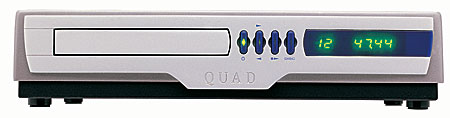
Nah, it didn't make me one with everything; it made me one that connects to everything. Well, almost. It packed a ton of function into a CD player—with a heavy emphasis on the fun. And it did it for $1350.
The 99 CDP-2 is a CD player. It's a digital switch box. It's an upsampling D/A processor that is specified as being able to handle 24-bit/96kHz PCM signals. It also has variable output. And its mama dresses it pretty—you get all of that in an attractive cast-aluminum chassis.
What did you do and when did you do it?
I first heard about the 99 CDP-2's immediate predecessor, the 99 CD-P, when I visited Quad's manufacturing facility in Shenzen, China. I was instantly captivated by the player's mix of functions, but when Julian Maddock began describing the CD-P's design genesis, I knew I had to get my hands on one.
Maddock startled us visiting journalists with his brutal assessment of Quad's CD forays over the years, accurately describing the original 99 CD player as having been compromised—"crippled" was his word, as I recall—by its use of a proprietary Quad bus-connection scheme. "Even if it had possessed great sound," Maddock said, "few people other than the owners of complete 99-series Quad systems would have ever known. However, the player was average—not what Quad had traditionally striven for."
So while the 99 CD-P was cosmetically part of the 99 series and included a Quadlink connection, it was designed from the ground up—or should I say from the ground plane up?
The chief designer was Jan Ertner, who had joined Quad during its glory years and left during its decline under the Verity Group. As part of IAG's attempt to return the marque to its former luster, Maddock brought Ertner back on board and turned him loose on the new CD player.
Ertner set to work on a player that would use a Philips transport and a 24-bit/192kHz Crystal DAC with 2x upsampling. After he'd come up with a working prototype, Maddock had a brainstorm. "Could we add digital inputs to this design, and how much would it add to the price?"
Ertner's answers were yes and about $40. But that wasn't all, he told Maddock. The upsampling would be applied to any digital input, and the DAC could accept PCM signals with up to 24-bit word length and 96kHz sampling rates. Maddock told him to make it so.
Then Maddock added another mizewell. (The term comes from home renovation, where customers frequently tell contractors, "While you're at it, you mizewell add another bathroom over here.") "How much would it cost to add variable output to the player for consumers who don't want—or need, now that the CD player accepts multiple sources—a preamp?"
Ertner's answer was that it could be done inexpensively or it could be done right, with a separate ground plane and power supply—in which case it would add about $90 to the price.
Another no-brainer. The 99 CD-P was born.
A 99 CD-P was not what I got for review, however.
During Ertner's design process, Philips decided to get out of the CD-transport business, which is why so many manufacturers now use data and DVD drive systems in their CD players. According to Maddock, there's a problem with this: CD players operate in the realm of 1x (real-time) reads, and those other drives are designed to crank along at higher speeds and read data multiple times to ensure accuracy. That means that the servos tend to overshoot in their error correction because of the need for speed in data recovery—relying on re-reading data, which isn't possible at 1x CD-reading speeds. Quad feels that the data drives that work so well in computers just don't cut it for audio.
So, Maddock told me, they hired Jon Green, one of the leading designers in Philips Optical's brain trust, to design a new, high-resolution CD transport for the 99 CD-P—which would now be called the 99 CDP-2—complete with a "unique bundle of laser reading strategies." This means that the CDP-2's transport isn't simply a drop-in replacement for the one in the CD-P, but Quad does offer the upgrade to owners of the original units.
While the box my review sample arrived in proclaimed it to be a 99 CD-P, the unit itself had a badge identifying it as a 99 CDP-2—which, by the way, costs the same as the original CD-P: $1350.
The 99 CDP-2 has a cast-aluminum shell with elegant crenellations along its rear edge. The front panel is simple: drawer, four CD-navigation switches, display. That's it. Digital source switching and volume control are assigned to the remote. The rear panel sports an IEC socket, fuse holder, mains switch, variable and fixed analog outputs, three coaxial data inputs, three TosLink data inputs, and a TosLink digital output. Quadlink in and out connections are provided.
Met him on a Monday, da doo ron ron
One of my typical "tests" of a component is to set it up and use it without reading the manual—or even, as my vision worsens, without sticking my face up against the faceplate to read the labels. So I connected the Quad 99 CDP-2 to the Conrad-Johnson Premier 350 power amp, powered it up from the rear-panel mains switch, and was surprised to discover that I'd immediately turned it off again with the front-panel power switch that I thought opened the CD drawer. Actually, I'd turned the player off again with the front panel power switch—which is located next to the drawer, where the open/close control usually resides. That switch is the one farthest from the drawer, and clearly labeled, if you actually pay attention to that kind of thing.
That settled, I connected my Polk XM Reference tuner and Musical Fidelity X-RayV3 CD player to two of the CDP-2's digital inputs and began listening to the Quad as the "brains" of a simple system driving the C-J power amp and a pair of Penaudio Serenade floorstanding loudspeakers.
Do/be do/be. Do!
My immediate impression was that music was less involving than it had been during my audition of the Viola Labs Cadenza preamplifier (reviewed in the December 2005 Stereophile). I wasn't exactly stunned by this—after all, I was replacing a $16,000 preamplifier and $6000 universal player (the Ayre C-5xe) with a $1350 one-box combo. Besides, I reasoned, the Quad needed to burn in.
Things improved as I logged more time on the 99 CDP-2, and the XM Reference tuner sounded a lot better than through its own D/A section, but I never really felt that I got the Penaudios singing the way I'd heard them do. Bass seemed a bit woolly, details were subsumed into the mix, and there just wasn't enough presence to engage me—something that was just as true when I listened to the X-RayV3 (footnote 1) as when listening to the same CDs through the Quad.
I inserted my Musical Fidelity Nu-Vista preamplifier between the 99 CDP-2 and the Premier 350 and switched over to the Quad's fixed outputs, leaving the X-RayV3 and the XM Reference connected to the CDP-2's digital inputs.
Oh my, yes indeedy. Houston, we have jump. Also snap, focus, and detail.
I don't want to completely dismiss the 99 CDP-2's variable output option. It's undeniably convenient—and that convenience is probably worth the $90 it adds to the price. I suspect this is why Julian Maddock was very careful to say that Quad doesn't consider the 99 CDP-2 a preamplifier–CD player, but rather a unit that is "95% a CD player, with some added features."
By the way, if I cranked the variable output fully open, I heard essentially the same sound I heard with the fixed output. That's pretty great, but the whole point of the variable output is using it to attenuate the sound of the player, and once I did that, its negative effect on the music was audible.
The 99 CDP-2's DAC helped the sound of digital components with iffy converters. The XM Reference was vastly improved through the Quad's converter, gaining in snap and focus. It remained somewhat swimmy tonally, but XM doesn't devote tons of bandwidth to any channel's signal, so there's only so much any DAC can do.
http://www.stereophile.com/cdplayers/106quad/
Saturday, September 29, 2007
Private Label Rights Audio - For Their Listening Pleasure
The day has come when the world and the people in it are just too busy to read anything. Think about it, with the invention and release of MP3 players, people on the go simply do not take the time to read books, articles, or anything for that matter. What they do instead is listen to them. That is right; they can download audio files right from the internet and listen to them while they are on the go.
Private label rights audio can help you tap into that market of people quickly and easily. The world in general is a busy place; it is time that your business starts catering to the busy professionals as well.
Private Label Rights Audio - The Key to the Future
PLR audio files can be found in many forms and types. The most popular audio files are MP3's. However, they may be found in midi, wav, or other types of audio files. The key is to find out just what your customers want. For the most part, it will likely be MP3's they are wanting, which are very easy to find.
So, what types of PLR audios are available? There are many different forms of audio available that you can begin offering your customers:
Audio Novels - Again, society is entirely too busy now days to take a few hours to read a book. Therefore, people are turning to the ability to listen as they go. With audio novels, they can listen to an entire book while they travel to and from work, exercise, cook, eat, or any other activity really.
Audio Self-Help Books - Self-help books are extremely popular. People are always looking for ways to improve their lives, abilities, and self-help books are the way to go. Again, the benefits are that they can listen to the book while they are doing almost any activity.
Audio Tutorials - Not everyone has the patience or ability to learn a new skill by reading an article, a tutorial, or a book. Why not offer your customers an easier method of learning.
Audio Lectures and Speaking Engagement - Do not worry about transcripts, offer your customers an easier way to listen and learn from speakers.
There is so much more available in the area of private label rights audio, such as music, courses, and the like. It is important that you tap into exactly what your customers need and want.
PLR Audio - How To Profit
The best thing about audio is that they can be downloaded right to any computer and used in a variety of ways. For example, a customer could listen to it right on their computer, burn it onto a disk for use in a CD player, or even transfer it directly to their personal MP3 player, listening to it while they are on the go.
The key to earning a profit with private label rights audio is to make sure it is of the highest quality and is of good content. With PLR audio, you are given the rights to edit, brand, and resell as you see fit. However, it is important to keep in mind that while you do have these rights, so do other people as well. You may have duplicated content. Therefore, you will have to work that much harder to get customers to choose you over another company.
You want to brand the PLR audio with your own business information, logos, and links. You can provide the audio files for direct downloads or include them with another product. For example, many people are offering e-Books for sale, but they also include an audio file of the same e-Book to provide more benefits to their customers, as well as make an additional profit.
Happy Listening For You And Your Customers!
http://www.goarticles.com/cgi-bin/showa.cgi?C=473111
Private label rights audio can help you tap into that market of people quickly and easily. The world in general is a busy place; it is time that your business starts catering to the busy professionals as well.
Private Label Rights Audio - The Key to the Future
PLR audio files can be found in many forms and types. The most popular audio files are MP3's. However, they may be found in midi, wav, or other types of audio files. The key is to find out just what your customers want. For the most part, it will likely be MP3's they are wanting, which are very easy to find.
So, what types of PLR audios are available? There are many different forms of audio available that you can begin offering your customers:
Audio Novels - Again, society is entirely too busy now days to take a few hours to read a book. Therefore, people are turning to the ability to listen as they go. With audio novels, they can listen to an entire book while they travel to and from work, exercise, cook, eat, or any other activity really.
Audio Self-Help Books - Self-help books are extremely popular. People are always looking for ways to improve their lives, abilities, and self-help books are the way to go. Again, the benefits are that they can listen to the book while they are doing almost any activity.
Audio Tutorials - Not everyone has the patience or ability to learn a new skill by reading an article, a tutorial, or a book. Why not offer your customers an easier method of learning.
Audio Lectures and Speaking Engagement - Do not worry about transcripts, offer your customers an easier way to listen and learn from speakers.
There is so much more available in the area of private label rights audio, such as music, courses, and the like. It is important that you tap into exactly what your customers need and want.
PLR Audio - How To Profit
The best thing about audio is that they can be downloaded right to any computer and used in a variety of ways. For example, a customer could listen to it right on their computer, burn it onto a disk for use in a CD player, or even transfer it directly to their personal MP3 player, listening to it while they are on the go.
The key to earning a profit with private label rights audio is to make sure it is of the highest quality and is of good content. With PLR audio, you are given the rights to edit, brand, and resell as you see fit. However, it is important to keep in mind that while you do have these rights, so do other people as well. You may have duplicated content. Therefore, you will have to work that much harder to get customers to choose you over another company.
You want to brand the PLR audio with your own business information, logos, and links. You can provide the audio files for direct downloads or include them with another product. For example, many people are offering e-Books for sale, but they also include an audio file of the same e-Book to provide more benefits to their customers, as well as make an additional profit.
Happy Listening For You And Your Customers!
http://www.goarticles.com/cgi-bin/showa.cgi?C=473111
ARTIST MANAGEMENT - 8 Reasons Why a Band or Artist Needs a Manager
To most musicians, the enduring image of an artist manager is a caricature of a heavy-set, unkempt slob of a man, stuffed into a 2-sizes-too-small, off-the-rack department store suit, chomping on a cheap smelly cigar while sliding a greasy hand unceremoniously into the back pocket of a starving artist. Surely, somewhere in the vast landscape of the music universe, such malice exists. The vast majority of artist managers, however, are a motley collection of well-meaning, hardworking, selfless individuals struggling to make the dreams of someone they believe in come true.
For the legion of dedicated unbelievers out there, this is an article that attempts to shed light on the true value of an artist manager. Following are 8 reasons why a band or artist needs a good manager:
1. Career Guidance - It's often extremely difficult for artists to step back from the day-to-day activities and see the big picture (you know - the old 'forest-for-the-trees' thing). A knowledgeable manager can see how everything in the big picture fits together, and can help the artist navigate through the often-confusing maze of activities that seem unrelated yet are all part of a massive jigsaw puzzle. The manager provides career guidance and helps to set the overall game plan for the artist and the artists' team to follow.
2. Cheerleading - Even though fans are the main cheerleaders for an artist, someone has to communicate the same enthusiasm to the music business community. An artist manager will trumpet the artist's message to record labels, booking agents, promoters, media personnel, club bookers, independent retail accounts, etc., in order to keep them all engaged and enthusiastic.
3. Prestige - According to most record industry professionals, there is something to be said about an artist that has a manager. The logic is that if an artist is good enough to attract management, there must be something of value present. In fact, most major labels refuse to sign an artist unless they have solid team (manager, attorney and publicist) in place. An artist without management is just too much drama! Labels would rather deal with someone who knows how the music business works and can make decisions on a non-emotional basis.
4. Buffer - A manager can act as an effective screening buffer between the artist and people that want to do business with the artist. This buffer tends to attract legitimate industry players while at the same time scaring away scam artists. There are no scarier words to a scam artist than "please talk to my manager".
5. Time management - There simply is not enough time in the day to do everything that needs to be done in order to further the career of an artist. In between writing songs, conducting interviews, designing artwork for CD's and merchandise, managing a mailing list, filling out copyright paperwork, rehearsing with the band, hiring and firing musicians, updating band websites and MySpace profiles, getting pictures taken, shooting and editing DVD's and YouTube videos, sending out packages and/or updating EPK's, researching, repairing and purchasing equipment, etc., there isn't time to also craft a master game plan, solicit potential sponsorship partners, handle licensing requests, reach out to industry gatekeepers, attend industry networking events, harass labels for tour support, and so on. Some tasks can be delegated to the band while others can be handled by the manager.
6. Accountability - Part of a manager's job is to hold people accountable. What happens when the financial tour support that was promised by the label fails to materialize? Or the check from the booking agent bounces? Or the FOH engineer at the show is MIA? Or the licensee fails to sign and return the contract but is using the artist's songs anyway? Or the beer in the tour van vanishes? Somebody has to keep people honest, and that is most appropriately the manager's job.
7. Good Cop / Bad Cop - Need to fire the bass player but don't want to create an enemy? Let the manager play bad cop and do the firing. Need to re-negotiate your contract and request more of a promotion budget? Let the manager play good cop and keep a positive spin on the proceedings. There are plenty of occasions when the artist and manager can trade off playing good cop / bad cop.
8. Sounding board - A manager, even though basically an "honorary member of the band", is frequently on the outside looking in. Managers usually see things differently than the artist, and can often provide different perspectives, insights and solutions to problems the artist is encountering. Running ideas by a knowledgeable manager prior to making decisions often allows for good ideas to become better and bad ideas to be removed altogether from the to-do list.
So, there you have it! 8 good reasons why an artist needs a manager. Having said all this, however, it is important to note that having a bad manager is worse than having no manager at all. Many wannabe managers think they can just "wing-it" with an artist, and continue to operate with the "lets-record-a-3-song-demo-and-shop-it-for-a-record-deal" mentality, even though the music industry continues to undergo significant changes. New business models are emerging, and only those managers that stay at the leading edge of the learning curve will create successful strategies and provide meaningful counsel to their clients.
http://www.goarticles.com/cgi-bin/showa.cgi?C=608298
For the legion of dedicated unbelievers out there, this is an article that attempts to shed light on the true value of an artist manager. Following are 8 reasons why a band or artist needs a good manager:
1. Career Guidance - It's often extremely difficult for artists to step back from the day-to-day activities and see the big picture (you know - the old 'forest-for-the-trees' thing). A knowledgeable manager can see how everything in the big picture fits together, and can help the artist navigate through the often-confusing maze of activities that seem unrelated yet are all part of a massive jigsaw puzzle. The manager provides career guidance and helps to set the overall game plan for the artist and the artists' team to follow.
2. Cheerleading - Even though fans are the main cheerleaders for an artist, someone has to communicate the same enthusiasm to the music business community. An artist manager will trumpet the artist's message to record labels, booking agents, promoters, media personnel, club bookers, independent retail accounts, etc., in order to keep them all engaged and enthusiastic.
3. Prestige - According to most record industry professionals, there is something to be said about an artist that has a manager. The logic is that if an artist is good enough to attract management, there must be something of value present. In fact, most major labels refuse to sign an artist unless they have solid team (manager, attorney and publicist) in place. An artist without management is just too much drama! Labels would rather deal with someone who knows how the music business works and can make decisions on a non-emotional basis.
4. Buffer - A manager can act as an effective screening buffer between the artist and people that want to do business with the artist. This buffer tends to attract legitimate industry players while at the same time scaring away scam artists. There are no scarier words to a scam artist than "please talk to my manager".
5. Time management - There simply is not enough time in the day to do everything that needs to be done in order to further the career of an artist. In between writing songs, conducting interviews, designing artwork for CD's and merchandise, managing a mailing list, filling out copyright paperwork, rehearsing with the band, hiring and firing musicians, updating band websites and MySpace profiles, getting pictures taken, shooting and editing DVD's and YouTube videos, sending out packages and/or updating EPK's, researching, repairing and purchasing equipment, etc., there isn't time to also craft a master game plan, solicit potential sponsorship partners, handle licensing requests, reach out to industry gatekeepers, attend industry networking events, harass labels for tour support, and so on. Some tasks can be delegated to the band while others can be handled by the manager.
6. Accountability - Part of a manager's job is to hold people accountable. What happens when the financial tour support that was promised by the label fails to materialize? Or the check from the booking agent bounces? Or the FOH engineer at the show is MIA? Or the licensee fails to sign and return the contract but is using the artist's songs anyway? Or the beer in the tour van vanishes? Somebody has to keep people honest, and that is most appropriately the manager's job.
7. Good Cop / Bad Cop - Need to fire the bass player but don't want to create an enemy? Let the manager play bad cop and do the firing. Need to re-negotiate your contract and request more of a promotion budget? Let the manager play good cop and keep a positive spin on the proceedings. There are plenty of occasions when the artist and manager can trade off playing good cop / bad cop.
8. Sounding board - A manager, even though basically an "honorary member of the band", is frequently on the outside looking in. Managers usually see things differently than the artist, and can often provide different perspectives, insights and solutions to problems the artist is encountering. Running ideas by a knowledgeable manager prior to making decisions often allows for good ideas to become better and bad ideas to be removed altogether from the to-do list.
So, there you have it! 8 good reasons why an artist needs a manager. Having said all this, however, it is important to note that having a bad manager is worse than having no manager at all. Many wannabe managers think they can just "wing-it" with an artist, and continue to operate with the "lets-record-a-3-song-demo-and-shop-it-for-a-record-deal" mentality, even though the music industry continues to undergo significant changes. New business models are emerging, and only those managers that stay at the leading edge of the learning curve will create successful strategies and provide meaningful counsel to their clients.
http://www.goarticles.com/cgi-bin/showa.cgi?C=608298
Subscribe to:
Posts (Atom)