Monday, June 18, 2007

Aurum Acoustics Integris CDP CD Player and Linestage

I don’t think I ever expected to get my hands on a piece of audio equipment as fine as this. In fact, there aren’t many as good as this. When it comes to the cost of an audio component (or anything else, for that matter) I want only value for money. But that is not as easy as it sounds and, one must be cautious, a bargain isn’t necessarily value for money. There are many fine CD players that are priced lower than the Integris CDP and there are several that cost multi thousands. The CDP, though, is more than a state of the art CD player. It is also a line preamp. You can pay many thousands for a standalone preamplifier. So, in the rarefied world of High End Audio, I define the CDP as value for money. The rest is simply pure delight.

The Component: it is a single box containing a player for 16 bit, or red book, Compact Discs and a line stage pre-amplifier. It has five buffered analogue inputs, five digital inputs and three outputs, one analog, and two Aurum Acoustics CDP Rear PCM digital. Switching among them is simple and noiseless. The transport is a silky smooth Philips 2M top-loader. Disc stability is assured with the use of a magnetic puck. Resampling is achieved with a Quantum digital processing module from Switzerland’s Anagram Technologies. This very sophisticated device is at the heart of the matter, and outputs a 24bit/192kHz signal.

The result achieved in the recovery of information from the common two channel CD is just astounding, as accurate and more detailed than any competing format. This is not the player if you are attracted to surround sound for music playback. This is not the player if you plan to line your walls with SACDs. This IS the player if you have a collection of Compact Discs and want to enjoy them more than you ever imagined.

The Integris CDP is a sterling example of the many advantages that, with care and good design, can be realized by putting things in one box. Having indulged in several years of outboard DACs and jitter boxes (remember Audio Alchemy?), I came to that conclusion long ago.

It’s not worth the inconvenience or the money spent on additional interconnects and power supplies and cords. The shorter and less cluttered the signal path the better. Having the preamp included is more than icing on the cake. It is accurate and very, very quiet. Having it coupled with the CD player in the one unit is the essence of flexibility and convenience. With the multiplicity of inputs and outputs it will accommodate all your stuff.

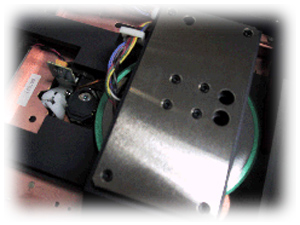
For example, LP playback from a phono section through an Integris line input works beautifully. Sound is wide-ranging and dynamic and the noise floor is considerably reduced. Should a phono section become available for the CDP you would see me first in line. Aurum Acoustics CDP Inside

One of the Integris CDP’s lasting virtues is that, with its modular design, it can be upgraded or have additional features added as they become available in the years to come. A more detailed description of the CDP can be found on Aurum’s web site.

The main functions of the Integris are controlled from the buttons on the machine itself. The supplied, quite remarkable, Harmony remote does everything, including adjusting absolute phase. It is programmed by downloading information from your computer.

The Set-Up: Easy, take it out of the box, make the connections and play. For best results you should use an isolation platform or accessory cones to support it. One of the most interesting things about the CDP is the way it reveals the differences between associated equipment and accessories. When it comes to connections, I had the chance to do some experimenting and I ended up with the Cardas Golden Reference power cord and Cardas Neutral Reference interconnects. I would like to try the more upscale Golden Reference ICs. If experimenting with interconnects and power cords appeals, then a competent dealer will (or certainly should) let you experiment from the stock of loaners until you have what you like. More than ever I realize when it comes to cables etc., there is no right answer but, BUT, you will hear differences.

My System: I am running the CDP directly into a pair of bridged Bryston 3BST amplifiers. My Brystons are connected to Wattgate wall outlets with WireWorld Electra III power cords. My speakers are the lovely PSB Stratus Gold i and the Speaker cable is Kimber Select 3033.

The Sound: Well, what do you expect when you drive a Lamborghini? You expect something that is beyond the ordinary and very special. So it is with the Integris CDP. The conventional wisdom with top-flight equipment is to say it neither adds nor subtracts. That is nonsensical when it comes to CD reproduction with the CDP. It simply does things to the bits that are magical. It transforms. I have had time to listen to a wide variety of material and everything sounds right. The sound stage is wide and deep, maintaining its proper dimensions all the way back. The imaging is rock solid, the trumpets stay in the trumpet section no matter how loudly they play or the tympani stay way in the back regardless of the amount of air they excite. The CDP’s ability to resolve the quiet stuff, low level information, which is where much of the sound experience gets its life, is one of its most remarkable features, and the music emerges from such quietness that it appears, unbounded, from its own unique world.

One of the jazz recordings I like, and like to listen to for system evaluation is John Scofield and Joe Lovano's Blue Note recording What We Do. With the CDP the sound is focused and beautifully staged. Bill Stewart’s drumming is hyperactive and he uses the whole kit. His cymbals sound sharp and steely or delicately filigreed. Snare and tom toms resonate or explode. They are all properly in place behind Scofield, who is slightly left and Levano's tenor, which is slightly right of centre. Scofield can get so many colours from his guitar. Changes take place in the flash of a second. Mind you, as much as I like it, this is not a perfect or purist recording and the CDP reveals all. For purist I go to AM’s The Bellingham Sessions, featuring Chuck Israels. Oh, boy, pure as the driven snow. It’s all there. You hear everything. Image stability is crucial when listening, especially to string quartets. Again, the CDP locates each player believably and at the same time they play together in their given space. You sense the musicians reacting to each other.

At the other end of the scale, the Integris conveys the thrilling power of a full symphony orchestra. Herbert Blomstedt’s San Francisco discs of the symphonies of Carl Neilson on Decca/London are a wonder. Recorded Aurum Acoustics CDP Remote in Davies Hall in the late 80s, their power is, well, thrilling. In the 4th and 5th noble, great music is dressed in compelling sound. You can hear mallets strike, drums resonate and sounds bounce off the walls, and that’s just the percussion.

I could go on, for example, the Mahler 3rd Symphony in the early 60s recording by Bernstein and the New York Philharmonic in the Sony 20bit reissue but let me say, overall, the frequency response is more even than I’ve ever heard it in my room. Bass is solid, clean and full of life. (I had to get used to the loss of mid-bass distortion). The midrange and high end deliver space, air, transparency and detail, detail, detail. All this with a sense of freedom that is continually engaging, helping you discover or rediscover no matter how familiar the recordings.

The Bottom Line: My time with the Integris CDP began with a quest to find a CD player that would satisfy me as much as the experience of listening to LPs. This component does that and much more (including making the LPs sound better). You will be surprised how many beautifully recorded CDs you have in your collection. Just yesterday I dug out a Hyperion disc from 1988 (Tony Faulkner, engineer) of music by John Stanley. I have always admired it but this time I couldn’t believe my ears. New digital recordings are stunning and historic reissues sound remarkably good upsampled.

Finally, everything I hear with the Integris CDP happens in the context of a complete lack of dreaded digital edge. You thought CDs automatically came with digital sound; not so, and the CDP proves it in a very elegant way. Obviously this is a very special, very high-end piece of business.

May I describe it as invaluable?

http://www.audio-ideas.com/reviews/digital-sources/aurum-cdp.html

Sunday, June 17, 2007

Sonos Digital Music System

Sonos Digital Music System - Zone Player 100 In his fascinating book Capturing Sound, How Technology has Changed Music author Mark Katz describes what he calls "Phonograph Effects". A Phonograph Effect, in short, is a manifestation of how recording technology has changed music. The roughly three minute playing time of a 78 rpm record, for instance, had a profound influence on the structure of early pop and jazz music. To most audiophiles the proposition that recording (and in our case playback) technology influences how music is not only consumed but produced will not likely come as any great revelation. Katz's analysis of phonograph effects, however, from the rapid evolution of vibrato in turn of the century classical music, right through his examination of the turntable as a musical instrument in hip-hop and DJ culture, is consistently insightful and absorbing.

As the book's early chapters explain, the introduction of the phonograph represented a seismic shift in the way people consumed music. Hearing an orchestra perform a symphony for instance, what was once a special privilege of an elite class, filtered down to the masses; something that was ephemeral (a live performance) became repeatable, reproducible and aggressively commoditized; record players gradually replaced pianos in the parlours of homes all over the world; in short order recordings became by far the dominant means by which people consumed music. Capturing Sound

If the 20th century was about recorded music's dominance, the 21st will be characterized by its ubiquity. From the vantage point of 2006 it's hard to believe that a little over one hundred years ago music couldn't exist unless you were making it yourself, or in the physical presence of someone who was. And then it was gone, never to be heard the same way again (with the possible exception of the player piano). Today, between portable players, car audio, and the garbage we're assaulted with in public spaces (ie shops, airports etc), let alone the home stereo, music is nearly inescapable.

Now that we've entered the era of file-based recordings and commercial music has been divorced from necessity of a physical carrier, a whole new range of Phonograph Effects (now perhaps better described as Ipod Effects) is emerging; another topic Katz covers in the latter chapters of his book. With CD sales waning, the notion of the album, which itself only rose to prominence with the LP, is rapidly being eroded by the resurgence of singles, now downloaded (legally and illegally) from the internet rather than stamped into 45s. Loading singles into playlists is, for many, creating a far more randomized listening experience, where rather than hearing a collection of songs released at the same time by the same artist ordered in a particular way for maximum impact, we're sampling one song at a time without always knowing what's coming next. Get enough tracks in a playlist and it's very much like having your own personal radio station, minus the advertising and (usually) inane chatter. This, as you would expect for technology still in its infancy, is just the beginning. The big changes are still to come.

Catching up with this new reality is putting the major record companies through rather unsightly public dry-heaves of panic and convulsions of misguided litigation. Hardware companies, however, are starting to figure it out. Clearly Apple has done a little more than just figure it out and pretty much owns the portable music player market, not to mention the legitimate online music business (over one billion song downloads and counting). But things at home are a little more complicated. We have yet to see a file-based music player for home systems that can rival the Ipod in terms of cutting-edge design and user-friendliness and, in so doing, mount a significant assault on entrenched CD/DVD players. That is until now.

http://www.audio-ideas.com/reviews/digital-sources/sonos.html


Friday, June 15, 2007

Hooking Up Your Stereo to Your PC or Laptop

If you're turning a computer into a music machine, why not just do the obvious: Hook it up to the stereo? If you want to make audiotapes of your MP3s (or even streaming audio concerts) for your car's tape deck, this is probably a good idea. Also, if your band wants to convert a demo tape into MP3 format for posting on the Web, you can reverse the hookup - that is, run the sound out from your stereo into the microphone jack of your computer.

If you just want to listen to music you find on the Web, you may find it easier to just invest in some high-end computer speakers. A basic computer can do the essential functions of your stereo:

  • Play compact discs.
  • Play high-quality sound through high-end computer speakers.

Stereo speakers are not magnetized in the same way as computer speakers. If you place your stereo speakers too close to your computer, they could damage your hard drive. Play it safe and keep at least a few feet of space between the two. Or, better yet, shell out some cash for a good set of computer speakers with a subwoofer.

The main reason most people seem to want to connect the two beasts is to crank their MP3s out of their stereo system. Just run the right-sized wires between the right places to turn your computer into a mighty combination MP3/audio CD player.

To connect your computer to your home stereo, follow these steps:

1. Turn down the volume on your stereo and sound card.

If you can't find your sound card's volume adjustment - which is either somewhere on the back of the card or through its software program - simply turn off your computer (after saving and closing any open files, of course).

2. Find the correct cable.

You need a shielded Y-adapter cable. This cable has a stereo 1/8-inch plug on one end and two RCA phono plugs on the other end. You can find the cable at Radio Shack. Other electronics stores and some computer stores carry the cord as well.

The package of a stereo Y-adapter cable often refers to it as "a male stereo 1/8-inch plug to two male RCA plugs."

The best sound card manufacturers throw the cord in for free; others make you head to Radio Shack. If your computer and stereo aren't very close together, pick up a 12-foot stereo cable. A 20-foot stereo cable provides even more room. If your computer and stereo are more than 20 feet away, ask the Radio Shack salesperson how to buy the right cable and plugs to make your own extension cable.

3. Plug the 1/8-inch stereo plug into your sound card's speaker jack.

Hopefully your sound card has all its jacks labeled so that you know which hole does what. If it doesn't, you have to open the sound card's manual. Then run the extension cord between your computer and your stereo system.

If you have carpet, push the cord into the crack between the carpet and the edge of the wall. Use the right tool for the job: A spoon handle works well. No carpet? One alternative is to buy a rug, but whatever you do, don't leave the cord laying across the floor.

4. Plug the cable's two RCA phono plugs into the stereo's Aux Input or Tape Input jacks.

Check the back of your stereo for some unused input jacks; you should see several pairs of stubby little metal heads. Use the Aux Input or the Tape Input jacks - whichever ones aren't being used.

One jack of the pair is probably red or labeled "Right" - push the cord's red plug into that jack. The other jack is probably black, white, or green - this jack is for your other plug, no matter what color it is.

Don't plug your sound card's output into your home stereo's Phono Input jack. Your stereo doesn't expect such a strong signal from that jack.

5. Turn on the stereo, and switch it to Aux Input or Tape Input.

Turn the stereo's input select switch to the jack that you've used, either Tape Input or Aux Input.

6. Play an MP3 file on the sound card, and adjust the volume.

Gradually turn up the volume on your stereo and sound card. If everything is hooked up right, the sound should start filling the room.

If the sound doesn't start filling the room, make sure that the stereo is turned to Aux Input or Tape Input - or whatever input jack you plugged the sound card into. If the stereo isn't turned to the correct input switch, your sound card won't come through.

http://tech.yahoo.com/gd/hooking-up-your-stereo-to-your-pc-or-laptop/153082;_ylt=An7grElJDzUXonxdPG7ie9QSLpA5

iPod Tips for FolksToo Busy for iPods


Despite the fact that I was one of the first people I know to have an iPod, my iPod and I have always had a troubled relationship. It's simply a matter of time. I don't really have time to put into making the relationship work.

As a matter of fact the happiest times in our relationship was when my youngest son was still at home. I bought him his own iPod on the condition that he give me a bit of space for me and my music.

It was a great solution. He had time to act as my surrogate, filling my iPod for me; I got to listen to my music and even some of his. If you have kids at home it's a strategy I'd strongly recommend.

iPod After the Kids Are Gone

When he went off to college even King Solomon couldn't figure out how to split our megabytes, so, like any good gadget-loving parent, I gave him the older iPod and bought a new one for myself.

Left on my own, I found out how many mistakes I could make on a device that by now the entire world thought was the most elegant user interface ever invented.

The biggest lesson learned: Don't rip your CDs if you're not connected to iTunes

Ripping a CD involves playing the CD in your computer's CD player and transferring its contents to your computer and then over to your iPod.

I have a pile of old CDs that I love and on weekends we have a 2 hour car ride up to our house in upstate NY. Since I'm always looking for life's efficiencies, I figured ripping my CDs to the computer as we drove North was a great move.

Wrong. The ipod gets its information about what the songs you're ripping from a little code that the iTunes database understands. If you're not connected to iTunes while you're ripping your CD you'll get a song called Track 01 rather than Times They Are a Changin' . Things like the name of the album, artist and song transferred. I burned disk after disk and all that my iPod could tell me about the song was "Track 01 " Track O2.

The Solution:

If you've made this mistake you can fix it. You can connect to the Internet and can replace the Track # information with the real CD information-song name, artist and so on. Go to the Advanced menu and after selecting the offending songs simply choose Get CD Track Names. iTunes will retrieve the names of your selected songs and apply them automatically, even if the CD is no longer in your computer.
http://tech.yahoo.com/blog/raskin/72;_ylt=AoJ6vpKFVIhoWJjyd1Hsp1ASLpA5

Thursday, June 14, 2007

Seeking Out Other Sources for Digital Music

You can purchase downloads or order CDs online all you want, but some other sources don't directly involve Windows XP. You can tie these sources into the computer eventually, but the first step is to move away from the computer and see what else is out there.

  • Concerts: Get out and see a live show! Not only will you likely have a good time, but you can also bring home a CD with you. Sometimes you don't even have to purchase them - up-and-coming bands may pass out samplers to promote their music, and even Prince included a free CD with every ticket on his Musicology tour.
  • Conferences: It's especially popular to give out CDs at conferences related to music for promotional purposes, but other industries (such as travel, wedding arranging, and so on) likely have sampler CDs or other musical items available from those looking for work. Again, it can be a good source of what's coming up musically. Pay attention!
  • DVDs: Some DVDs include a second disc that carries digital sound files of music from the movie. You can listen to these files, and you can use the included Acid Xpress software to remix the songs - talk about great building blocks! Other DVDs are packaged with extras like audio CDs and other musical goodies. Shop around!
  • Video games: If you want to hear some unreleased tracks from certain artists, head to your latest video game console. From Journey to the Wu-Tang Clan, artists have coupled their music with the video games. You may not be able to play these songs on your computer or CD player, but it's worth it to a completist to pick up these games.
  • Giveaways: The marriage of Pepsi and iTunes was just the first of corporations giving away songs to attract attention to their offerings. Sony has also given away music to sell its products. As more online music stores jump into the fray, look for some free offers to expand your collection.
  • Used CD stores: One man's trash is another man's treasure. If you look hard enough, you can find some obscure gems in the cutout bins. Just because the CD didn't sell well doesn't mean it doesn't have good music. And more-popular CDs make their way into used CD stacks for a variety of reasons. Check it out, save a buck, and add to your digital music collection.
  • Promotional offers: You've probably received more than one CD in the mail as an incentive to buy an upcoming release. This may become a more rare occurrence as online distribution of music becomes more popular, but CD sales still ring the cash register. Therefore, companies still want you to buy their product and promote it to get those sales. Look for fan clubs and other artist organizations and sign up. You may get more promotional messages from the artist as a result, but that's the price you pay.
  • Satellite radio: This digital broadcast can be taken from car to home to office, depending on the receiver you buy. Both Sirius and XM Radio offer many channels dedicated to different genres and interests. It's like having Internet radio stations wherever you go. You can hear emerging artists and get more information on music than you normally would with regular radio. It's a premium service, but it's well worth the investment if you want more than normal radio broadcasts can offer.
  • Digital cable: Digital cable provides a lot of options, including high-speed Internet connections and music channels. These channels provide commercial-free music through your TV (and any entertainBlogger: Information On CD Player Articles and News - Create Postment center options you have hooked up to that TV). The channels offered depend on your cable provider, but you should be able to find something palatable.
  • "Bonus" tracks: Whether it takes the form of "hidden" tracks on CDs (unlisted tracks placed at the end of recordings) or promotional EPs attached to magazines like Rolling Stone, the incentive is still the same. You get something more with the same purchase price. Especially notable is the CMJ New Music Journal, which includes a full sampler with the purchase of each month's issue. That's a great deal of music for the regular price.
http://tech.yahoo.com/gd/seeking-out-other-sources-for-digital-music/153233;_ylt=AoPK5eFZwT7rDFFbCLw9HBgSLpA5

Covering Music Toys for the Truly Geeky

Part of the fun of having new portable audio toys is adding accessories to make them do exactly what you want in exactly the way you want. This list takes a look at some of the more unique and unusual items custom-made for those hardcore enthusiasts who want something different and special.

  • SliMP3: This tiny device appeals to both geek function and fashion. The player attaches to an Ethernet connection and connects to the user's PC, which acts as a server. It can play either MP3 files from the computer or streaming radio from Shoutcast or Live365. The device is a transparent combination of plastic and circuit boards, with a readout for artist and song information.
  • LT Laser Turntable: If you've ever wanted to spend as much on an audio component as your first car, this is a great place to start. The LT Laser Turntable produces audiophile-quality sound, and the laser used in the reading process does not cause the wear and tear a needle can produce when dragged across vinyl. This device is only recommended for those who want to keep their old records in really good shape.
  • Philips MCi250 Wireless Broadband Internet Micro HiFi System: Quite a name, eh? This player needs a long name to describe everything it does. Not only can this stereo system play normal CDs and receive local AM/FM stations, but it can also receive Internet radio stations over your home wireless network. You can also use the system to find out more information about the songs you hear on the radio. Finally, you can get MP3 files from your computer and listen to those as well. This device frees your audio from your computer and puts it anywhere in your house.
  • Belkin iPod Backup Battery: You're on a long journey, and you can't make it to a wall outlet or FireWire cord to recharge your iPod. The music can keep on going if you have this external battery backup available to you. This device claims to add 15 to 20 additional hours to the life of your iPod and may allay your fears over nasty reports about the iPod's battery life.
  • Laks Memory Music Watch: Check the time and hear the rhymes on this combination timepiece/flash memory portable audio player. This watch carries 256MB of memory, along with an integral MP3 player and USB connection. You can even use it as a portable storage device for other files.
  • C. Crane FM Transmitter: This device is one of the many transmitters made to broadcast portable digital audio files to an FM radio anywhere, anytime. This one stands out for its ability to transmit anywhere within the listenable FM spectrum up to a distance of 70 feet. You could conceivably force everyone in the house to listen to whatever you want, and isn't that what you've always wanted to do anyway?
  • Groove Bag Tote Speaker Purse for iPod: The looks of the iPod are praised almost as much as its functionality, so it's only natural that fashion accessories would follow the technological lead. Felicidade made this bag with both style and usability in mind. The purse contains both a carrying pouch for your iPod and two small speakers that make the purse act like a portable stereo. Finally, fashion sounds as good as it looks.
  • Sonic Boom Bag: Portable audio players are great, but not everyone is the purse-carrying type. For those who fall into a different bag, this backpack features a flat-panel speaker system built into the fabric. You can place any CD player or portable audio device into the case, and a volume control is located in a carrying strap. This should be enough to keep you mobile and entertained for a long time.
  • PlusDeck 2: The PlusDeck 2 is a cool idea. This cassette player fits into the same kind of slot used for CD or DVD drives in your computer, and it can both record and play back audio through Windows XP. It even comes with its own recording software. Now you can make modern MP3 mix tapes the old-fashioned way.

Technology changes at the speed of science, so if you stay in tune with the times, you're bound to hear of even more fun gadgets and gizmos to wow even the most hardcore enthusiast.

http://tech.yahoo.com/gd/covering-music-toys-for-the-truly-geeky/153213;_ylt=Ao.DJwF_YchyHyzGbUvu8.QSLpA5

Wadia 861se CD Player

For however many audiophiles, the compact disc is it. In terms of its catalog’s girth, it’s no way near certain that any post-"Red Book" format will ever replace the CD -- serious music lovers have seriously large CD collections. Philovinylite grievances notwithstanding, the CD having so swiftly usurped the LP’s predominance will likely find no parallel soon. On the sound systems on which we lavish our love and resources, we play virtually no other medium.

Let’s assume I address here those thoughtful souls who observe the adage "Less is more," or would like to. I imagine you saying, "I play nothing but CDs. Why do I need a preamp, an unnecessary complexity within the signal path? I’ve only to locate a CD player that has its own good volume control." You’ve come to the right place, pilgrim. Here I cover the Wadia 861se, a high-end CD player with its own very good volume control (see "Last gasp"). But you others need not leave the room. This component can coexist in comfort alongside any preamp you own or contemplate acquiring.

Mine is a CD-only, preampless system. I acquired a Mark Levinson No.39 CD player for, among its other virtues, a volume control that permits me to run one pair of interconnects between player and amps. A few years on, when the upgrade became available, I shipped the No.39 to Madrigal Audio Labs, Mark Levinson’s then parent company, to have it converted to a No.390S.

I’ve been a happy listener. For audio journalists, happiness is neither a God-given nor a legislated right. Change and challenge keep us alert, and we need to maintain an impartial demeanor. Therefore, in disinterested pursuit of Truth, Beauty, and the Audiophile Way, I’ve done my level best to keep a lid on my enthusiasm for a CD player that shares the No.390S’s uncommon feature: a good volume control.

Sometimes, ignorance is bliss. At other times . . .

I need to get out more. Our parent publication’s éminence grise informs me that Audio Aero, Esoteric, Resolution Audio, Krell, and Wadia make or have made CD players with volume controls, Wadia since 1992. Still, such players constitute a mere crumb of an already thin slice of market-share pie.

With its impressive heft (48 pounds, 17"W x 7"H x 16"D) and medieval-fortress look -- those redoubtable corner turrets! -- the Wadia 861 Special Edition, or 861se ($9950 USD), commands attention. Cold, out of the box, one strength was instantly apparent. More on that soon enough. Like just about everything associated with high-end audio, the 861se requires a burn-in period. If you keep the unit powered, a recommended practice in any event, a week should do.

Working up to least

When I first acquired it, programming my Mark Levinson No.39 to engage its volume control taxed my ability to follow directions. When I had the player upgraded to a No.390S, I hoped I wouldn’t have to repeat the onerous drill. Fortunately, it was still in its volume mode. The 861se’s designers obviously saw volume capability as a major attraction and opted for the easiest possible operation -- plug and play and you’re on your way. The Volume Up and Down controls are there on the player’s five-button face, and of course on the massive metal remote. ("Got a permit for that thing, fella?") If you’re using the 861se with a preamp, by and large you need only set the volume to maximum ("100" on the index scale).

Wadia prefers that the average listening level, absent a preamp, be set at "75" or so. If the end-user finds that he’s doing most of his listening at a lower setting, he can access two sets of DIP switches on the main DAC board to achieve the recommended level. Wadia will provide instructions, and it’s no big deal. However, if the very thought of wielding a 5/32" hex driver gives you the fantods, your dealer will oblige.

But then, you won’t have had the opportunity to ogle the 861se’s impressive innards. Wadia’s website details the 861’s features, as well as what sets the Special Edition apart from its $3500-less-expensive brother. Meanwhile, the owner’s manual, also available on the website, explains advanced programming options, none of which requires internal adjustment. At dummkopf level, where I’m most comfortable, the Wadia’s a snap.

As to what the user need not fret over, the manual suggests that, soundwise, outboard line conditioning and aftermarket power cords might do more harm than good. As I’d just concluded a celebration of an Isoclean power ensemble, I looked forward to deciding if Wadia’s caution has it right.

On to the nitty-gritty, easy on the grit

I first plugged the 861se’s stock power cord directly into an audio-dedicated wall outlet and got what sounded, at that early stage, like a delightful result. Playing an original-instruments recording of Beethoven’s Piano Concerto 1, with Steven Lubin, fortepiano, and Christopher Hogwood conducting the Academy of Ancient Music [L’Oiseau-Lyre 421 408-2], I was hard-pressed to hear a difference between the 861se’s no-frills cord and Isoclean’s Super Focus cord and its filter-transformer ensemble. These comparisons bore repeating.

The low Chinese cabinet on which the digital gear sits is a less than good foundation. The No.390S has its compensation in an SRA Ohio Class isolation platform. However, if I was to make a reasonable comparison between the Wadia and Mark Levinson players, they needed to operate under matched conditions. Out of scrap 5/8" plywood, I cut platforms to size for both players and isolated each from the resonant cabinet top with a quartet of Vibrapod Vibracones.

The No.390S had been enjoying the benefit of an Isoclean power cord and line-conditioning ensemble of filter and transformer. These had to go too. As mentioned, I was using the Wadia with its stock cord plugged into one of the FIM 880 outlets I’d had installed for the audio system. Into another discreet FIM 880 went the No.390S’s power cord -- not the superb Isoclean Super Focus, but as close a match to the Wadia’s as I could find in the attic, where I’ve tossed sufficient A/V oddments for a long weekend’s garage sale.

The best-laid plans

Having established close to identical playing conditions for the Mark Levinson and the Wadia, I never got beyond the 861se. There it sat on its jury-rigged slab and Vibracones, no-account power cord in place, charming the birds out of the trees. Engaging doesn’t half say it. There was no ambiguity about what I heard -- this was an extraordinary player. The idea of a direct comparison was depressing.

One fool rushing in

My model audiophile maintains a sonic beau ideal -- a reference -- against which he compares recordings and components. I’m most impressed by qualities that position a recording that much closer to the live event, which in my case means a production that attempts to sound like, or perhaps even to idealize, the sound of unamplified symphonic and chamber-music concerts, lieder recitals, jazz sets, gamelan gong, gagaku -- whatever -- in which instrumentalists and vocalists push air together in real time. This evaluative mindset precludes studio laminates and obviously doctored sound. But here I’d best insert a parenthetical mostly. If, for example, the production team adds a judicious pinch of reverb to a dry acoustic, you won’t notice the artifice. If you do, it’s too much. I’m not extolling minimalist-purist technique so much as admiring whatever best gets the job done.

Even so, I’ve not come close to what it is about the 861se that so beguiled my ear. The quality I noticed at that preliminary moment with the Beethoven concerto spelled itself out disc after disc. Simply put, the Wadia filled the room. I don’t mean to say that the soundstage was necessarily larger -- it was a question of my being more in touch with it. The impression was one of deeper involvement. The player commanded my attention. Despite the advantage of its SRA platform and Isoclean power ensemble, when compared with the 861se, the No.390S sounded just a bit remote and constricted. I would never have thought so had I not had the chance to experience the Wadia.

To best illustrate, I’ll remain briefly with one recording, a beautifully produced DDD CD released in 1983, about the time audiophiles began decrying the medium: Ravel’s two piano concertos plus a pair of shorter works, with pianist Pascal Rogé and Charles Dutoit conducting the Montreal Symphony [London 410 230-2]. Ray Minshull produced and John Dunkerly recorded. Ravel wrote his Concerto for the Left Hand for Paul Wittgenstein, the philosopher Ludwig Wittgenstein’s brother. The pianist, who had lost his right arm in the Great War, soldiered on with his left. The concerto is, for Ravel, a peculiarly ominous work, yet brilliant and virtuosic where it needs to be, and this is the best performance I’ve so far heard on disc. I’ve played it dozens of times, which means, for our purposes, that I’m familiar with its sound.

With the Wadia, I heard the heightened illusion of a large orchestral force and soloist performing on a concert stage. While I’ve said that the 861se "filled the room," the sense of distance a given recording established (a production decision) remained much the same -- which is why I’m having so difficult a time describing my experience of "deeper involvement." Effective stereophonic sound makes one’s speakers "disappear" to a greater or lesser degree. Never had my Wilson Audio WATT/Puppy 7s seemed less connected to the soundstage before me. The image’s dimensions were those of the performance space, not the distance between or beyond the speakers.

How, I wonder, did the 861se accomplish this so well? Page 17 of the owner’s manual covers three easily programmed digital algorithms. Algorithm A, the one I used, is described as "Wadia’s classic time-domain interpolation algorithm [delivering] a robust sound with extraordinary image focus and re-creation of recorded space." We’ve been conditioned to dismiss self-applied terms such as "extraordinary" as hype. Here, not. I would indeed call the sound I heard -- always, of course, courtesy of a good recording -- extraordinary: extraordinary dynamic "snap," extraordinary "air," extraordinarily lifelike space and sense of seamlessness, along with a smidgen of je ne sais quoi.

From the manual: Algorithms B and C focus, respectively, on a "more extended top end than Algorithm A" and the "high frequency extension and superior detail resolution of Algorithm B, but with a more relaxed presentation overall." The other two were a cinch to check out -- I stayed with A. From the website: "The algorithms include the latest version of Wadia’s classic DigiMaster time-domain interpolation filter which is optimized to preserve subtle time and phase information critical to music reproduction, delivering robust sound with extraordinary image focus and re-creation of recorded space." So it seemed. I played enough recordings, from the monumental to the intimate, to validate that claim.

Last gasp

A milled chassis and such are a treat to the eye. Nevertheless, a CD player that costs close to $10,000 had better have more than a pretty face. The Wadia 861se exceeded my expectations, and the thing is a pleasure to operate. For example, when you mute it, the volume dips discreetly to nothing; when you take it out of mute, the volume rises with equal discretion, as a balm to frazzled nerves. When you check out algorithms during play, the same genteel behavior obtains. I call that thoughtful.

I made several comparisons between the Wadia connected to the Isoclean power ensemble, Super Focus power cord included, and direct to a wall outlet with its own stock cord. My Mark Levinson No.390S profits from the Isoclean pieces -- differences with and without the Isocleans’ participation are clearly audible. It was a tougher call with the 861se. While I think I heard a difference with the Isocleans, I formed a strong and positive opinion of the player when it was plugged directly into a wall outlet. I suggest living for a while with Wadia’s recommendation: at some later time, check out whatever you have on hand in the way of designer power cords and power conditioning. I don’t recommend acquiring aftermarket accoutrements specifically for the 861se unless the dealer permits a home trial.

While the track and timing display on the faceplate’s readout window are adequately large, the information at the bottom of the window -- volume setting, choice of algorithm, channel balance, phase inversion, etc. -- were difficult to read from my listening position of about 10’ distant.

Received wisdom has it that analog volume controls are better than their digital counterparts, which, at lower listening levels, are obliged to shed bits and therefore resolution. Wadia’s website offers a technical explanation for their digital volume control’s superiority over analog. I’ve no idea whether this is based on solid engineering or wishful thinking. My guess is, the former. I can report with certainty only that I experienced no deprivation at whisper-quiet levels.

When a component’s qualities make the music lover forget he’s listening to a disc, he’s that much closer to heaven. Purely in terms of involvement and enjoyment, the 861se remained, from fff to ppp, a remarkable component.

http://www.ultraaudio.com/equipment/wadia_861se.htm